
the outlier №284
a north london myth and i want you to be happy

I’m Ben Mercer and welcome to The Outlier. This letter covers a lot of ground — taking in my move from pro rugby player to author and online man of letters — with reflections on books, interesting individuals, cross-cultural connections and the odd detour.
I’ve got so many drafts on the go, so many ideas in the works and so much I wanted to pick up from last week but, for better or worse, Arsenal won the English Premier League this week for the first time in 22 years.
For a longtime fan, it’s felt a little mythical and I’ll talk through it below.
This week, paid subscribers received an In Progress where I combined snippets and spoken commentary to create a kind of hypertext, sharing articles and quotes and explaining why they resonated with me.
I spoke about the tension between creating content and art, why the book industry should learn from film studios’ mistakes, something very French to say and why you shouldn’t track your running online. Have a look below (and please consider a paid subscription while you do).

A reminder to the paid subscribers, your private podcast feed, books and narrations all live in The Outlier Library. I’m also working on an online shopfront that you’ll of course receive privileged access and discounts to so it’s a good time to go paid if you’ve not already.
In terms of other stuff, it’s mostly behind the scenes again with the studio getting some lovely new lighting, some video editing, reading a very good book I’ll share with you at the end and lining up the next tranche of stuff to do.
For next books to read, if you fancy joining us in the boys book club in reading Lily King’s Heart The Lover, grab a copy now!



for your interest
a north london myth
This Sunday, Eberechi Eze will return to Crystal Palace where he and the rest of the Arsenal team will be feted as a Premier League winner. The hometown hero returns a champion.
At the beginning of the season, Eze was about to sign for Arsenal’s bitterest rivals Tottenham Hotspur. Eze, a former Arsenal youth player, called Mikel Arteta and changed the course of his destiny. On Sunday, Tottenham are playing to remain in the Premier League. Eze will be putting a winners’ medal around his neck and resting up before a European Cup final against Paris St Germain.
The road not taken and all that.
When I was 10, I chose to support Arsenal FC.
I got a shirt but left the name blank. Perhaps I didn’t know enough to commit to one or perhaps I had a sense the players would always change. Later as a pro rugby player, I would understand this feeling all too well.
Most of my friends picked United or Alan Shearer’s Blackburn, quickly contending they’d ‘always liked’ Newcastle when he moved for a brief world record £15 million.
Arsenal were hardly a niche choice though. That first year I paid attention they were the best team and won the 97-98 double. They had the English backbone, with Adams and the boys in defence, and glamorous foreigners like Bergkamp, Vieira and Overmars further forward. The manager was a tall, thin, aesthete, a professorial Frenchman. That team later became the Invincibles, after one French prodigy in Anelka left and another one in Thierry Henry arrived.
It’s easy to feel pleased about being an Arsenal fan. They felt like the best of being English, homegrown heroes buttressed by classy global imports; Bergkamp, Henry, Fabregas. For a boy growing up in the Wiltshire countryside near the small city of Bath, they felt impossibly urbane, diverse, stylish, they had verve, Gallicness and cool.
Then the club had to move forward and build a new stadium. This arrived at the exact wrong time, as former vice-chairman David Dein said,
‘Roman Abramovich has parked his Russian tanks on our lawn and is firing £50 notes at us.’
Suddenly the rules had changed and Manchester City changed them again when a nation state bought a once relatively parochial club. Arsenal were now a second class elite outfit, hamstrung by debt and faced by new rivals not playing by the same rules. We resigned ourselves to second best. It was only later, when the full scale of the fiscal disparities came to light, that you realised how amazing a job Arsène Wenger did to keep the team in the Champions’ League for all those years. He was playing against a stacked deck.
Since then, following Arsenal has always required a sort of gallows humour. They’re always going to look pretty good, you know they’ll fall short of the very best.
I feel a little bit the same about my relationship with London. I turned down an offer to study at UCL but I always thought I’d end up here, harbouring vague dreams of living somewhere like Islington or Bermondsey.
I did get here in the end but I can’t help but feel like I missed the boat.
I missed the 2012 Olympics, busy amusing myself with rugby in Sydney for the year, and now I’m here, not only have many of my friends left but the city has become extraordinarily expensive. Now, with the possibilities of working online and the sense you’re gettign less and less for more and more, I wonder whether I missed the glory days of living in London altogether.
But I still feel justified in following Arsenal. There’s a sense of unfairness about the other teams’ success and a lingering sense of aesthetic and coolness about the club. Even during the fallow times, the team aspired to attractive football and the kit and content is always good, even when results don’t match. I still like being in London but I can say with confidence that I still love following Arsenal. I think it’s made me both romantic and resilient.
There’s nothing more romantic than playing sport for your hometown team and when it happens, there’s nothing crueller than having that dream taken from you.
Eberechi Eze was released by Arsenal aged 13.
‘That was the worst one’
He said he cried for a week. He was subsequently signed and released by Fulham. Reading looked at him and passed. Millwall took him for two years but didn’t offer him a professional contract.
When he was 16, Eze tweeted something:
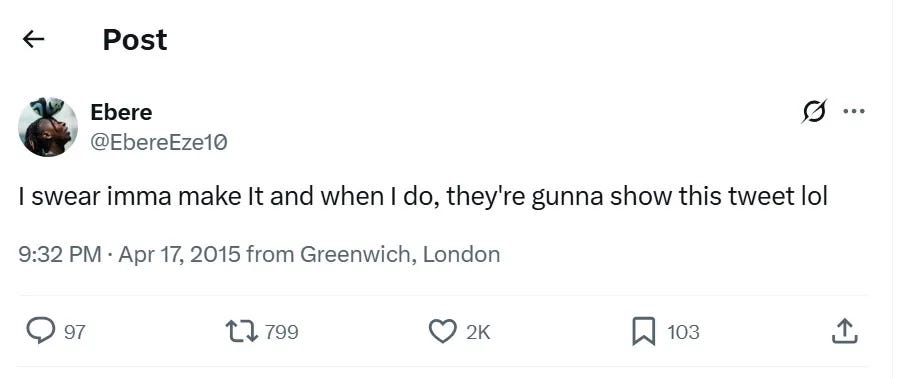
He was finally signed as a professional by QPR as an 18-year-old. From there he progressed to Crystal Palace where he became a star, won the FA Cup and represented his country. Then he returned to the team who rejected him 10 years before.
Looking back, Eze’s tweet feels prophetic but at the time, it was just a teenager refusing to give up.
It’s easy to give up. Life gives you plenty of opportunity to do just that. Give up on a dream, on a relationship, on something that feels hard. When you see someone who has stuck with it, through the slings and arrows of outrageous fortune, you can’t help but smile and be inspired.
This entire Arsenal team has refused to give up. Pushed on by their manager, former player and club captain Mikel Arteta, they’ve persisted through successive second place finishes, injury crises and, despite the largesse of their own American billionaire owners, they’re still playing against an organisation that holds a fistful of credit cards full of Gulf oil money.
It’s not been pretty like old Arsenal teams. But then, the 2026 edition hasn’t caved like you felt those teams would. This team have defeated not only their rivals, they’ve defeated the narrative around them, the version of themselves that couldn’t get over the line and win when it counted.
We live in an age of metrics and memes. Football discourse is expected goals at one end and ‘bantz’ on the other and both are reductive. One lacks sophistication and context while the other lacks feeling. Both hint at something true but they won’t tell you how or why a teenage Eberechi Eze refused to be cowed by multiple rejections. They won’t tell you why thousands of people converged on an empty Emirates Stadium to celebrate through the night, or why Eze, Saka, Rice and Timber went there in the early hours of the morning.
They did those things because there is something in the narrative, something powerful and strange and circular. It’s like it’s been written.
But it hasn’t.
Sport is unnecessary and often unpalatable. There’s plenty about it not to like. But this week, even in my ordinary world following along on my phone from across the capital, it felt like something magical was happening.
Last week I was in Kendal looking at the ruins of a castle and felt a sense of something lost – an empty, elegiac feeling for a forgotten, mythic version of Britain. But myth is right here. It is around us. Even amidst the sirens and the concrete, people are writing new ones now, in real life.
i want you to be happy
I really enjoyed Jem Calder’s debut novel I Want You to Be Happy.
Detailing the burgeoning relationship between Joey, a 23-year-old barista and aspiring poet, and Chuck, a 35-year-old copywriter who dreams of literary success, the book explores love, ambition, insecurity in present-day London.
It’s all very recognisable, from the delivery apps and phone-scrolling to the awkward, and less awkward dates and Calder is very good at sentences. He’s funny, he verbs things nicely and he also does great internet, capturing how life online permeates the real world without ruining the prose or the narrative. Jem Calder is clearly a very, very skilful writer.
It’s not a revolutionary story but the age gap is nicely navigated, with all its attendant imbalances, and there’s a good level of ambiguity as we approach the denouement. I read the book very quickly, keen to see what happened.
If I had a criticism, it’s perhaps that this book is probably meant exactly for me, made by English Literature grads for English Literature grads who live in London. It seems a little on the nose with its characters’ creative ambitions, both of whom aspire to some kind of literary stardom, the most appealing kind of stardom for people in the publishing industry.
Don’t let that put you off though. I Want You to Be Happy is a great summer literary read and with its very good cover, everyone will know exactly how clever and tasteful you are reading it.
I Want You to Be Happy – amazon / independents


a listen
I never realised this song was a cover, nor had I ever seen the brilliant video accompanying the Fiona Apple version.
a quote
Deep in the human unconscious is a pervasive need for a logical universe that makes sense. But the real universe is always one step beyond logic.
― from Dune
lastly
Thanks for reading! My work is made possible by you so if you’d like to support me you can buy my books, hire me to do something or you can become a paid subscriber using the button below.
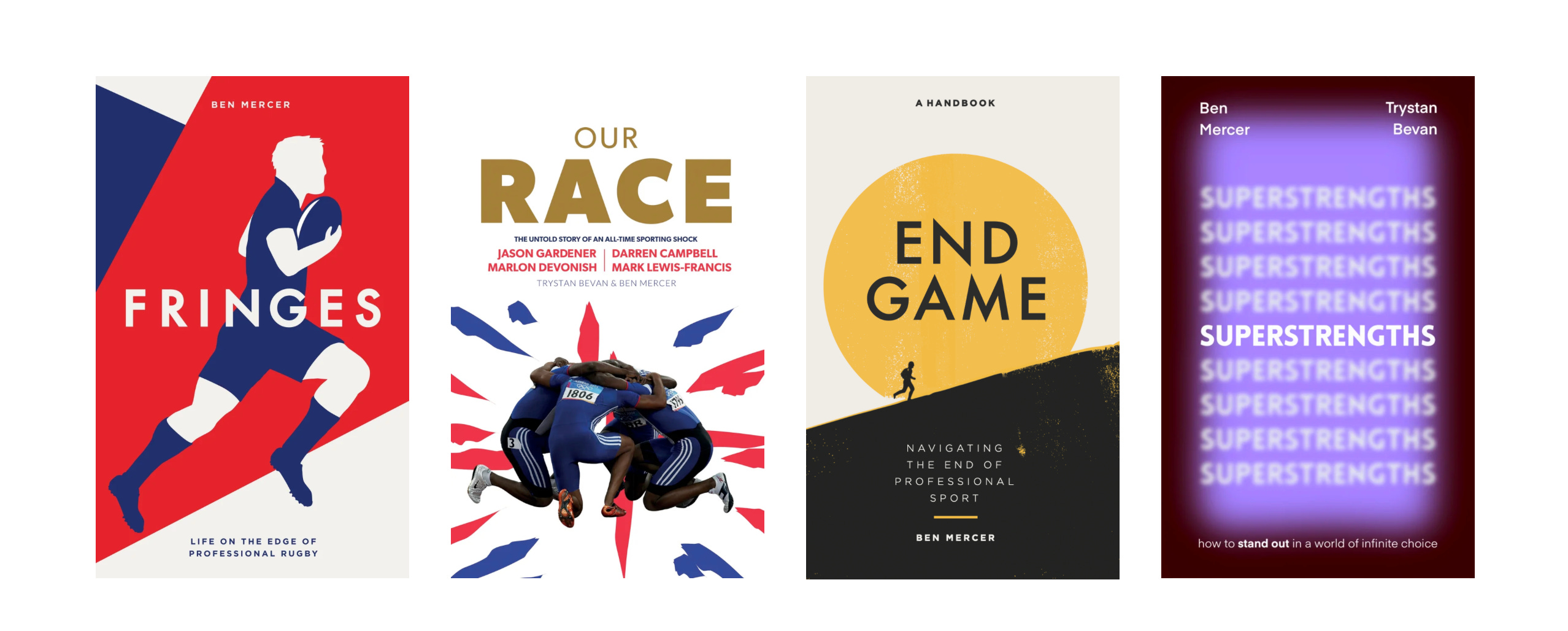
If you want to help me out for free, you can share this letter with someone who might enjoy it, either on social media or by directly sending it to them using the button.
I’ll see you next time.